
Everyday Verbs 동사
Action words for daily life — eat, sleep, go, buy.

Ad
 1 / 23
 Verbs are the engine of every Korean sentence, and the dictionary form always ends in -다. To speak politely you change it to 해요체: 먹다 becomes 먹어요, 가다 becomes 가요 and 공부하다 becomes 공부해요. Many verbs are short and native, like 가다 (go), 오다 (come), 먹다 (eat) and 보다 (see), while others are noun plus 하다, such as 공부하다 (to study). Verbs come at the end of the sentence: 저는 밥을 먹어요 (I eat rice). Learn these twenty-three everyday verbs first, and you can already talk about most of your day, from waking up to going to sleep.

Learn each verb with one object that goes with it, such as 밥을 먹다 or 영화를 보다; whole phrases are easier to remember.
Word list
Tap a card to start the player from that word.
- 가다gada to go
- 오다oda to come
- 먹다meokda to eat
- 마시다masida to drink
- 자다jada to sleep
- 일어나다ireonada to get up / to wake up
- 보다boda to see / to watch
- 듣다deutda to listen / to hear
- 말하다malhada to speak / to say
- 읽다ikda to read
- 쓰다sseuda to write / to use
- 사다sada to buy
Ad
- 주다juda to give
- 받다batda to receive
- 앉다anda to sit
- 서다seoda to stand
- 걷다geotda to walk
- 뛰다ttwida to run
- 만나다mannada to meet
- 공부하다gongbuhada to study
- 씻다ssitda to wash
- 웃다utda to laugh / to smile
- 하다hada to do
Ready-to-use sentence
- 뭐 해요?What are you doing?
- 밥 먹었어요?Have you eaten?
- 어디에 가요?Where are you going?
- 조용히 말하세요.Please speak quietly.
- 공부하고 있어요.I am studying.
Frequently asked questions
Why do verbs end in 다?
다 is the dictionary ending; in speech you replace it with endings like 어요 or 아요.
What is the difference between 먹어요 and 드세요?
먹어요 is plain polite; 드세요 is honorific, used when the person eating is someone you respect.
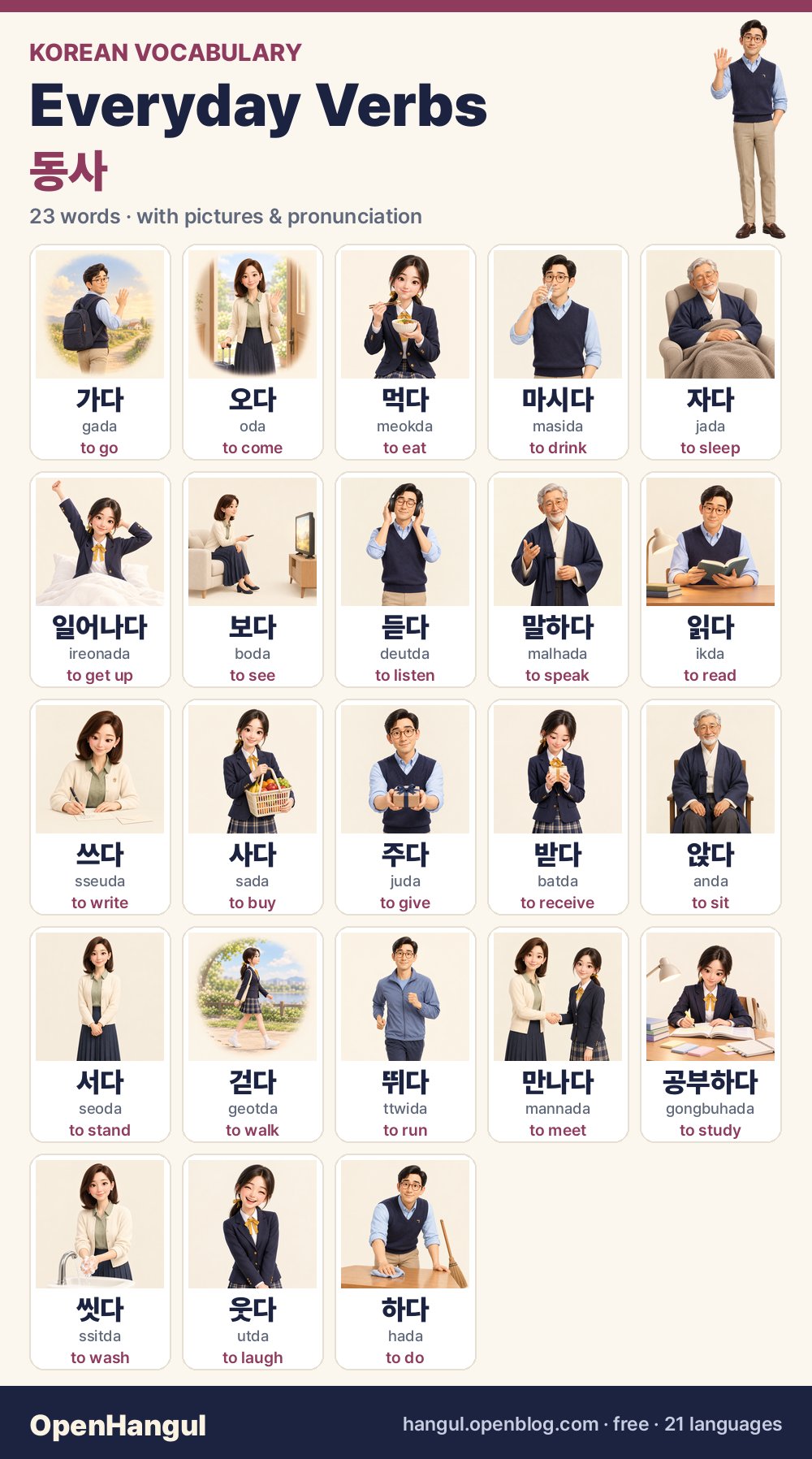
Word chart on one page
Save it and review whenever you have a spare moment. Feel free to share it with friends.
Save word chart imageAd