
Feelings & Emotions 감정
How to say happy, sad, tired and more.

Ad
 1 / 20
 Feelings in Korean are mostly described with adjectives and verbs that end in -다 in the dictionary, such as 기쁘다 (to be glad) and 슬프다 (to be sad). In conversation you change the ending to 해요체: 기뻐요, 슬퍼요, 화나요. Koreans often add words like 너무 (so) or 정말 (really) to show strength. A few feelings use the particle 가/이 with a verb, such as 화가 나다 (to get angry) and 걱정이 되다 (to be worried). Use these words to answer the common question 기분이 어때요? (How do you feel?), and to understand the emotions of the characters in K-dramas and K-pop lyrics.

When someone asks 기분이 어때요?, answer with a feeling plus 요, for example '기뻐요' or '피곤해요', instead of just 'good'.
Word list
Tap a card to start the player from that word.
- 기쁘다gippeuda to be glad / joyful
- 슬프다seulpeuda to be sad
- 화나다hwanada to get angry
- 무섭다museopda to be scary / to be afraid
- 놀라다nollada to be surprised
- 행복하다haengbokada to be happy
- 피곤하다pigonhada to be tired
- 외롭다oeropda to be lonely
- 부끄럽다bukkeureopda to be shy / embarrassed
- 걱정되다geokjeongdoeda to be worried
- 지루하다jiruhada to be bored / to be boring
- 신나다sinnada to be excited / to have fun
Ad
- 긴장되다ginjangdoeda to be nervous
- 짜증 나다jjajeung nada to be annoyed
- 졸리다jollida to be sleepy
- 기대되다gidaedoeda to look forward to
- 미안하다mianhada to be sorry
- 고맙다gomapda to be thankful
- 사랑하다saranghada to love
- 편안하다pyeonanhada to feel comfortable / at ease
Ready-to-use sentence
- 기분이 어때요?How are you feeling?
- 정말 기뻐요!I am really glad!
- 걱정하지 마세요.Do not worry.
- 괜찮아요?Are you okay?
- 미안해요, 고마워요.Sorry, and thank you.
Frequently asked questions
What is the polite ending of 기쁘다?
기뻐요; the 으 drops and the ending changes to 어요.
How do I say I feel something strongly?
Add 너무 or 정말 before the feeling, for example 너무 기뻐요.
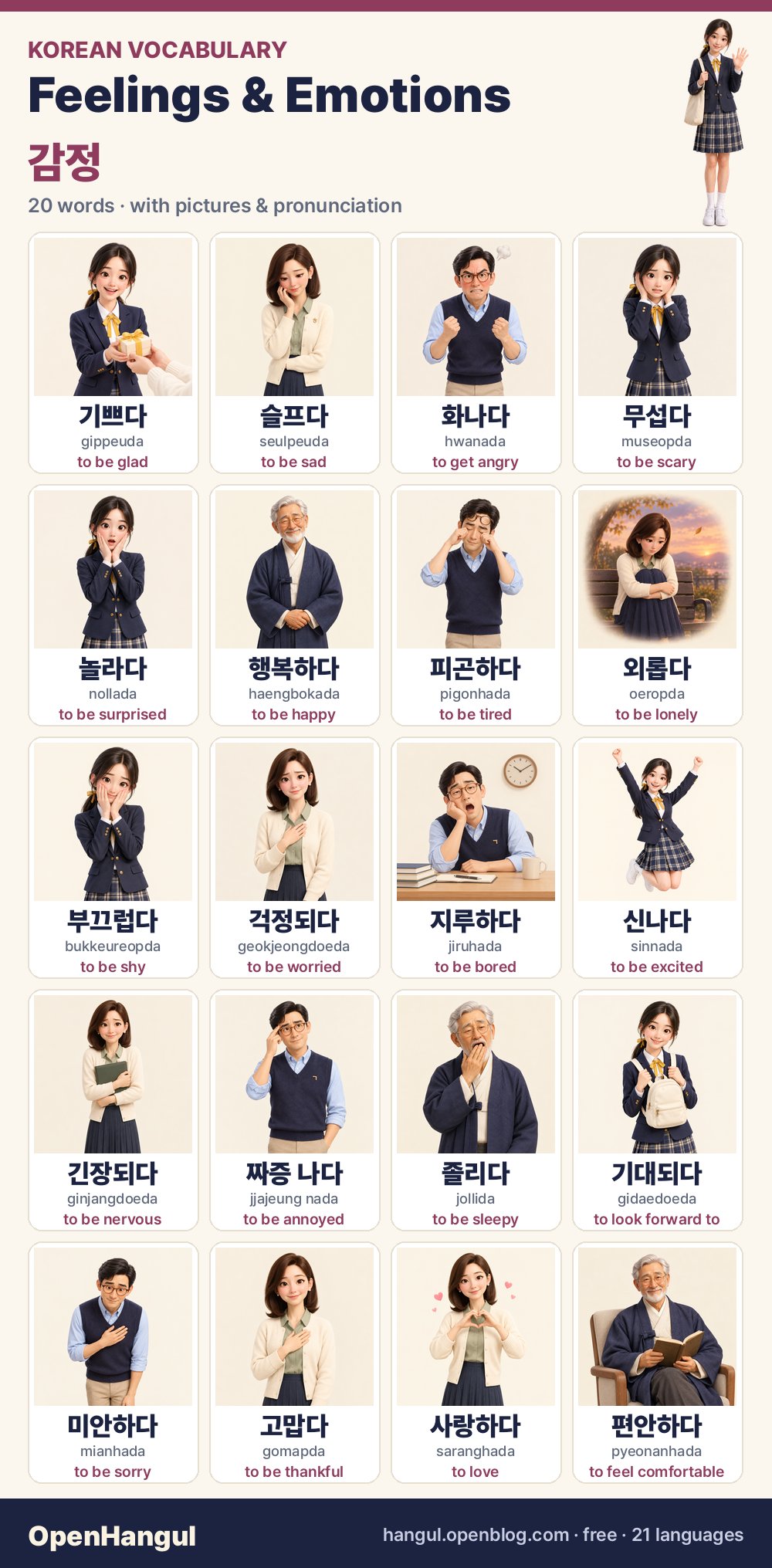
Word chart on one page
Save it and review whenever you have a spare moment. Feel free to share it with friends.
Save word chart imageAd