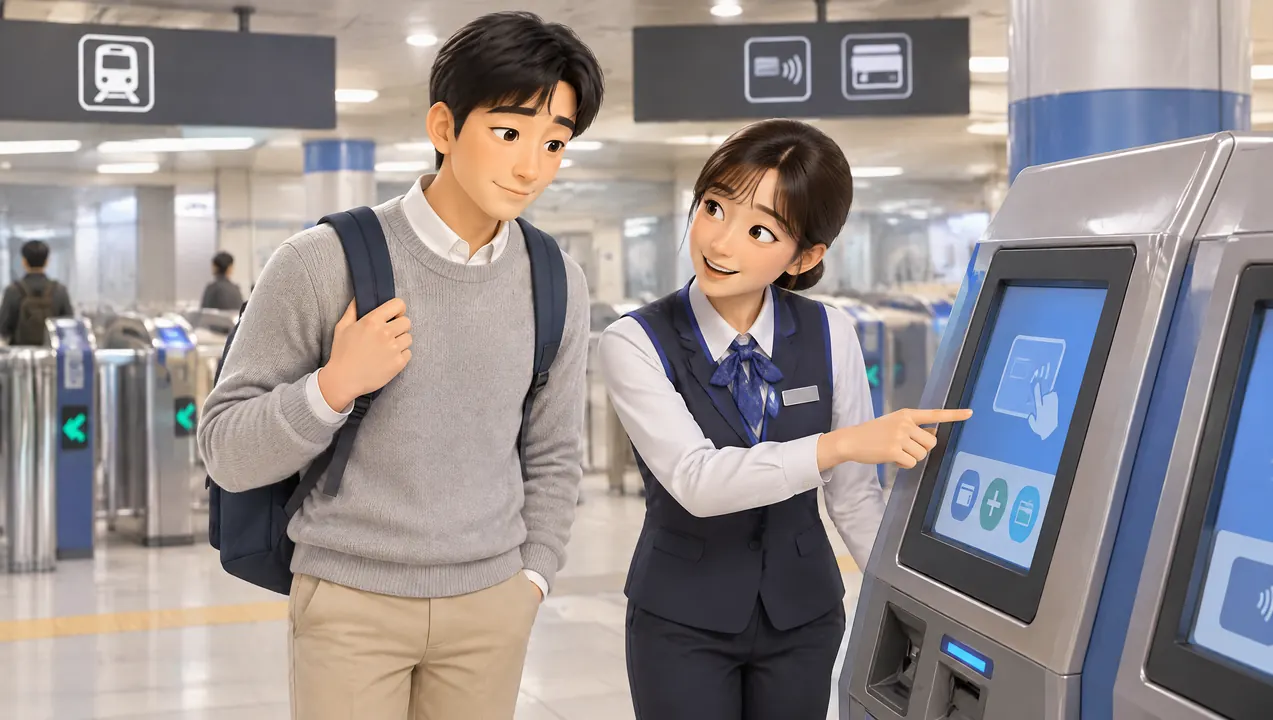
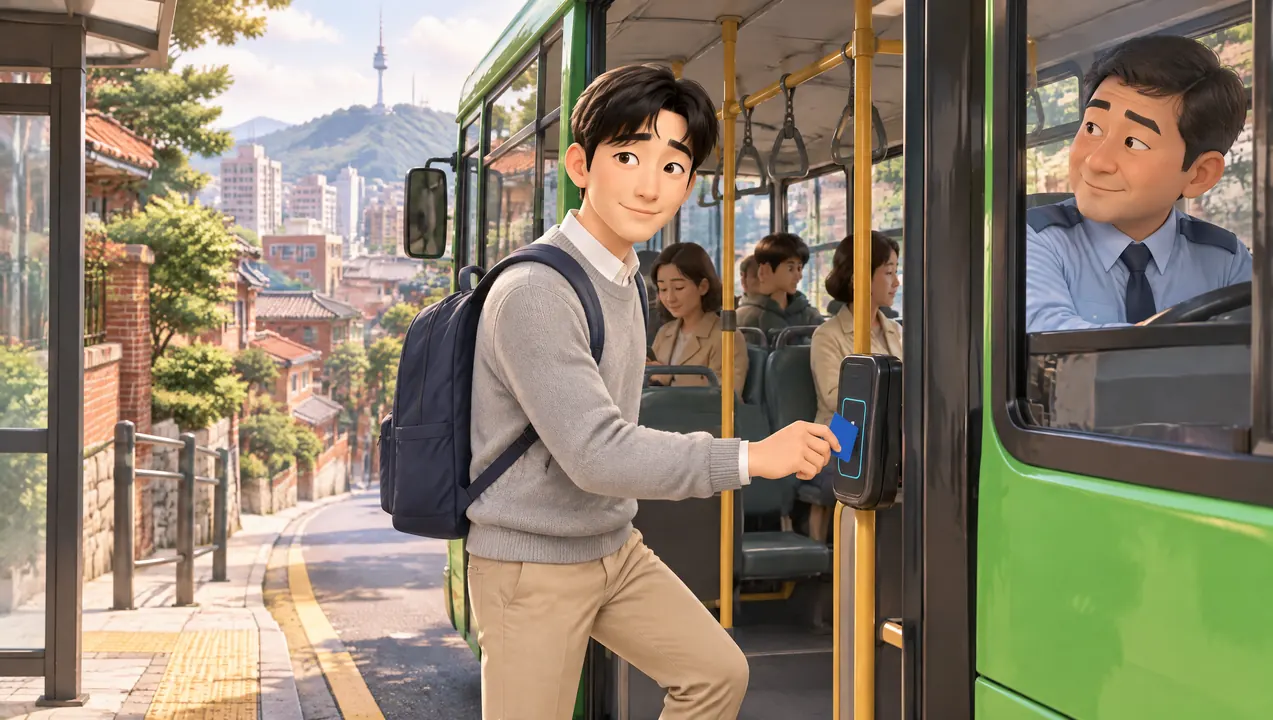
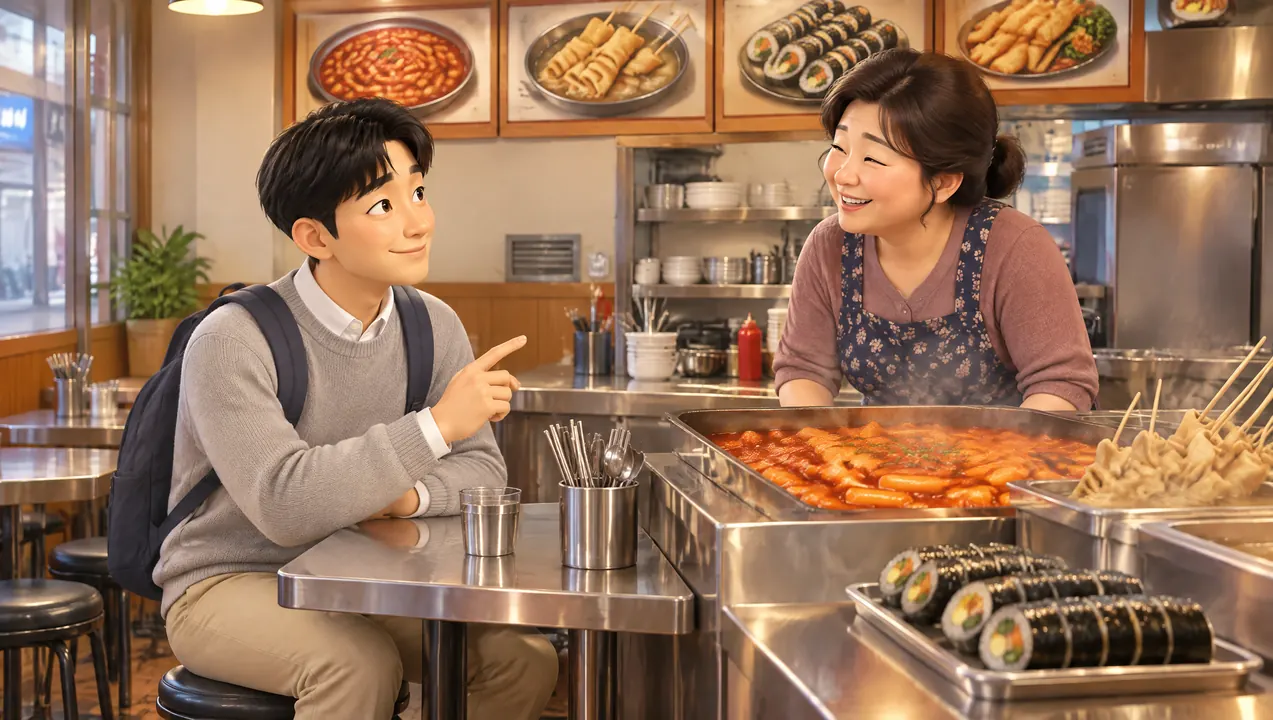
On his first Sunday, Minjun explores Garam-dong. He asks the way to the station, tops up his transit card, rides the village bus, visits Sua's flower shop, orders at a snack bar, drops off laundry, buys medicine, and gets lost until Narae helps him home.
How to study
Listen to the whole conversation (▶ Play all)
Read the key expressions and explanations
Tap each sentence to hear it, then say it out loud
Take on one role and practice the dialogue
Turn the switch off to hide the translation and see only Korean.
Scene 1
역이 어디예요? Where Is the Station?
민준
직원
민준
직원
민준
직원
민준
Key expressions
실례지만
쭉 내려가세요
오른쪽으로 도세요
Read the teacher's explanation
To ask a stranger, start with 저기요, excuse me, and add 실례지만. 실례지만 means, excuse me, but, and makes your question very polite. Then the man says 이 길로 쭉 내려가세요. Go straight down this road. 쭉 means straight on, without stopping. And 사거리에서 오른쪽으로 도세요. Turn right at the intersection. 오른쪽 is right, 왼쪽 is left. Remember these, and you can ask the way anywhere in Korea.
Scene 2
교통카드 충전 Topping Up a Transit Card
민준
직원
민준
직원
민준
직원
민준
직원
Key expressions
어디서 해요?
충전할게요
현금만 돼요?
Read the teacher's explanation
Minjun asks 교통카드 충전은 어디서 해요? Where do I top up my transit card? Noun plus 은 or 는, then 어디서 해요, and you can ask where to do almost anything. He says 만 원 충전할게요. I'll charge ten thousand won. Verb plus 을게요 tells the other person what you're going to do. And 현금만 돼요? Is it cash only? 만 means only. In many stations, card top-ups at machines are cash only, so carry a little cash. Now you be Minjun!
Ad
Scene 3
마을버스 타기 Taking the Village Bus
민준
직원
민준
직원
민준
민준
직원
Key expressions
기사님
몇 정거장 가야 돼요?
여기서 내릴게요
Read the teacher's explanation
In Korea, call the driver 기사님. 님 shows respect. To check the route, say 이 버스 가람시장 가요? Does this bus go to Garam Market? Just put the place before 가요. Then 몇 정거장 가야 돼요? How many stops do I have to go? 정거장 is a stop. When you want to get off, press the bell, or say 여기서 내릴게요. I'll get off here. 타다 is to get on, and 내리다 is to get off.
Scene 4
수아의 꽃집 At Sua's Flower Shop
수아
민준
수아
민준
수아
민준
수아
민준
Key expressions
뭐 찾는 거 있어요?
이걸로 할게요
서비스로
Read the teacher's explanation
Shop staff often ask 뭐 찾는 거 있어요? Are you looking for something? When you decide, say 이걸로 할게요. I'll take this one. It works in shops, cafés and restaurants. Here's a fun one: 서비스. In Korea, 서비스 means something extra for free. Sua says 서비스로 리본 달아 줄게요. I'll add a ribbon for free. Also notice 씨 after names: 민준 씨, 수아 씨. It's a polite way to call adults who are about the same age. This time, you play Sua!
Scene 5
분식집에서 At the Snack Bar
직원
민준
직원
민준
직원
민준
직원
Key expressions
일 인분
덜 맵게 해 주실 수 있어요?
먹고 가요, 포장해 가요?
Read the teacher's explanation
At a Korean snack bar, food is ordered by servings: 일 인분, one serving, 이 인분, two servings. Kimbap is counted by rolls, 줄: 김밥 한 줄. If spicy food is hard for you, ask 덜 맵게 해 주실 수 있어요? Could you make it less spicy? 덜 means less, and 더 means more. Then you'll hear 먹고 가요, 포장해 가요? Eat here, or take it to go? Answer 먹고 갈게요, I'll eat here, or 포장해 주세요, to go, please.
Ad
Scene 6
세탁소 At the Dry Cleaner
민준
세탁소 사장님
민준
세탁소 사장님
민준
세탁소 사장님
민준
Key expressions
드라이 맡기려고요
지워질까요?
언제 찾으러 오면 돼요?
Read the teacher's explanation
Koreans say 드라이 for dry cleaning. 드라이 맡기려고요 means, I'm here to leave this for dry cleaning. 맡기다 is to leave something in someone's care. When you're not sure, ask 지워질까요? Will it come out? Verb plus 을까요 asks for the other person's opinion. And 언제 찾으러 오면 돼요? When can I come and pick it up? Here 찾다 means to pick up something you left. You'll use the same question at repair shops and tailors too. Now be Minjun!
Scene 7
약국에서 At the Pharmacy
약사
민준
약사
민준
약사
민준
약사
약사
Key expressions
어디가 불편하세요?
목이 아프고 콧물이 나요
푹 쉬세요
Read the teacher's explanation
At a Korean pharmacy you'll hear 어디가 불편하세요? Where does it bother you? Answer with the body part plus 아파요. 목이 아파요, my throat hurts. 머리가 아파요, I have a headache. A runny nose is 콧물이 나요. For medicine, listen for 하루 세 번, three times a day, and 식후, after meals. And the kind goodbye: 푹 쉬세요. Get plenty of rest. 푹 means deeply, completely. Koreans say it to anyone who looks tired or sick.
Scene 8
길을 잃었어요 Lost on the Way Home
나래
민준
나래
민준
나래
민준
나래
민준
Key expressions
혹시
찾고 있는데 잘 모르겠어요
저 따라오세요
Read the teacher's explanation
Narae starts with 혹시, by any chance. 혹시 길 잃으셨어요? Are you lost, by any chance? Adding 혹시 makes a question softer and more polite. Minjun answers 찾고 있는데 잘 모르겠어요. I'm looking for it, but I'm not sure. Verb plus 고 있어요 means, I am doing it right now, and 는데 adds background before the main point. Then Narae says 저 따라오세요. Follow me. And what are the flowers for? It's a secret! Now one more time, you be Minjun.